
Deep Litter vs Cage System: Which Is Better for Layers and Broilers?
Deep litter vs cage system is one of the biggest housing decisions in poultry farming, whether you keep laying hens for eggs or raise broiler chickens for meat. The system you choose decides how many birds fit in your shed, how healthy they stay, how much labor you need and how much profit you make per bird.
This guide compares both systems for layers and broilers, using university trials, FAO guidance and extension advice. If you are still planning, read how to start layer chicken farming and our broiler chicken feed guide alongside it, and check layers chicken housing requirements for shed dimensions.
Deep litter vs cage system
For laying hens, cages usually deliver more eggs per bird, lower mortality and far more birds per house, while deep litter gives better welfare and costs less to build. For broilers, deep litter (floor rearing) is the standard, and with good litter it matched or beat cages in a recent trial. In short, cages suit large commercial egg farms; deep litter suits meat birds, small flocks and welfare-minded egg producers.
Key takeaways
- Cages hold far more hens: about 0.46 sq ft per bird in cages against about 2 sq ft on deep litter (TNAU). A Kenyan comparison puts a 300 m² house at 6,000 to 8,000 caged layers versus about 1,800 on litter (The Standard).
- In a controlled ISA Brown trial, caged hens laid more eggs and fewer died, while deep litter hens had better welfare but lower yield (Acta Veterinaria Brno).
- In a trial of 240 Ross 308 broilers, floor-reared birds had less footpad dermatitis and cleaner plumage than caged birds when litter was in good condition (Journal of the Hellenic Veterinary Medical Society).
- Wet litter is the main risk of deep litter for both layers and broilers.
- A slatted-plus-litter floor is a proven middle path.
What is the deep litter system for poultry?
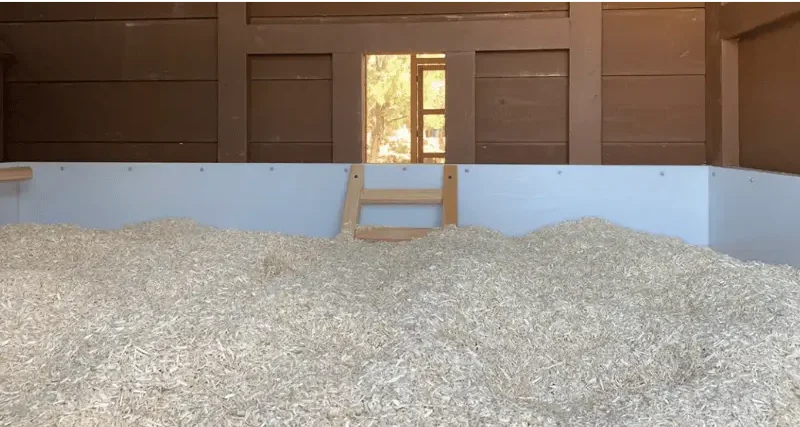
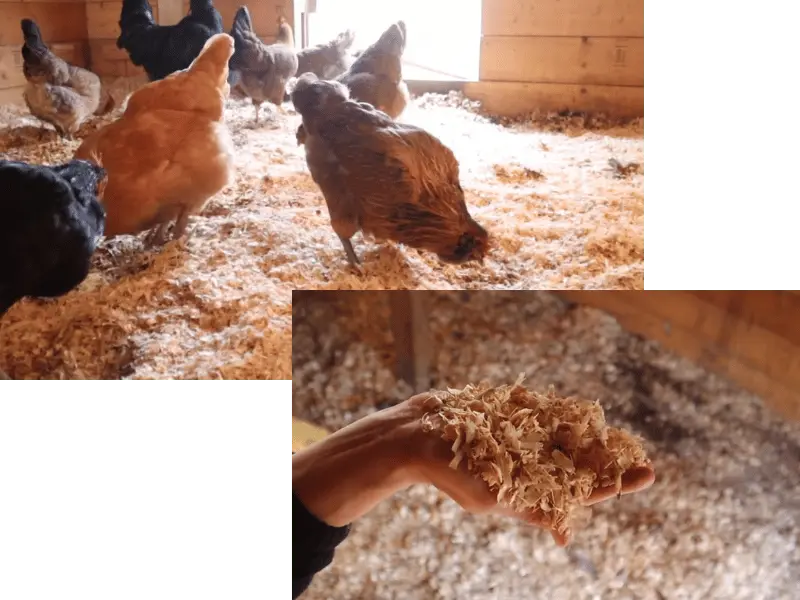
Before comparing deep litter vs cage system on numbers, it helps to see how each works day to day. In a deep litter system, chickens live loose on the floor of a closed shed covered with a bed of dry litter such as rice husk, wood shavings or chopped straw. The bed absorbs droppings and moisture, and birds scratch, dust-bathe and perch on it.
Depth depends on the bird. TNAU extension guidance recommends spreading layer litter up to about 6 inches, while broiler guidance sets a minimum of about 5 cm (Farmers Weekly). The FAO describes deep litter housing as protective and reasonably priced, with the need for good-quality litter as its main drawback (FAO).
What is the cage system for poultry?
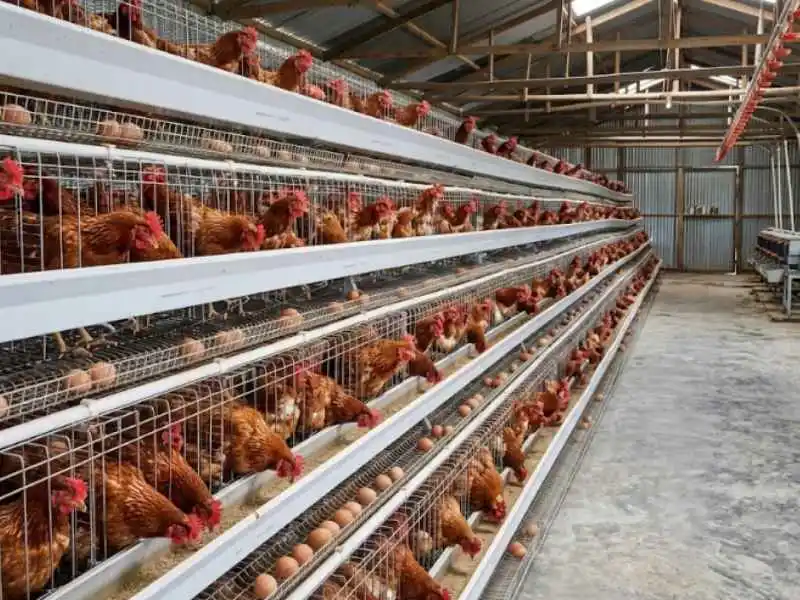
In a cage system, birds live in wire compartments stacked in tiers. Layer cages usually hold four to five hens each, with nipple drinkers, feeders along the front and a sloped floor that rolls eggs forward. Droppings fall through the wire onto belts or into a pit. Commercial layers commonly get about 450 cm² each (The Standard).
Because hens never touch their manure, eggs stay cleaner and parasite pressure is lower. The trade-offs are real: Ugandan farming coverage links battery cages to leg problems, cage fatigue and fatty liver, and manure removal and flies are the biggest daily headaches (Daily Monitor).
Cages are mainly a layer technology. The same Ugandan source advises against them for broilers and larger indigenous chickens, which outgrow the compartments.
Deep litter vs cage system for chickens: side-by-side comparison
| Factor | Deep litter | Cage system |
|---|---|---|
| Best suited to | Broilers, backyard hens, cage-free eggs | Large commercial layer farms |
| Space per adult layer | about 2 sq ft | about 0.46 sq ft |
| Layers in a 300 m² house | about 1,800 | 6,000 to 8,000 |
| Build cost per bird | Lower | Higher |
| Layer egg output | Lower in trials | Higher in trials |
| Layer mortality | About 1 to 2 points higher | Lower |
| Broiler footpad health | Good on dry litter, poor on wet litter | More dermatitis in one trial |
| Broiler suitability | Standard system | Rare; birds outgrow cages |
| Welfare and behavior | Scratching, dust-bathing, perching | Restricted movement |
| Daily labor | Raking litter, frequent egg collection | Manure removal, fly control |
Deep litter vs cage system for layers: cost, eggs and welfare
Cost: which is cheaper?
In the deep litter vs cage system cost debate, the answer depends on what you count. Cages need more money up front: the Kenyan comparison estimates about Sh350 extra per bird to convert a floor house to cages, and a Nigerian ISA Brown trial recorded the highest construction cost for battery cages (Bulletin of the National Research Centre).
But cages pack roughly three to four times more hens into the same building, so the cost per laying bird often narrows. Deep litter looks cheaper on paper, yet you pay in land, litter and labor. Run your numbers against our poultry farming business plan before committing.
Egg production and egg quality
Research is fairly consistent that cages produce more eggs per hen. In a Czech trial with ISA Brown hens, caged birds laid more eggs and more egg mass per day and fewer died, although they also had more cracked eggs (Acta Veterinaria Brno). A 2024 study of four housing systems likewise found lower egg production and egg mass in cage-free systems, with lower albumen height in deep litter hens (NCBI/PMC).
Egg quality is mixed. Another Czech comparison found deep litter eggs were heavier with darker yolks but had lighter shells (Czech Journal of Animal Science). Feed and a good layer breed such as the ISA Brown matter as much as housing for shell quality; see best layer chickens to compare options.
Health, mortality and welfare
Cages protect hens from droppings and parasites, so mortality tends to run 1 to 2 percentage points lower. Deep litter hens express natural behavior and often show better feather condition, though the 2024 study found they were more sensitive to handling. Calm, consistent management matters in both systems.
Deep litter vs cage system for broilers: growth, health and litter
Broiler chickens grow fast and heavy, which is why meat birds are normally raised on the floor, not in cages. The research backs that up, with one big condition: the litter has to stay dry.
What the trials show
In a 2025 trial, 240 one-day-old Ross 308 male broilers were reared to 42 days in either sledge cages or on litter. Birds on litter tended to finish heavier, had cleaner plumage and had far less footpad dermatitis. Walking, standing and feather-pecking behavior was similar in both systems. The authors concluded that floor rearing performed better when litter condition was good (Journal of the Hellenic Veterinary Medical Society).
Litter quality decides the outcome
Deep litter is not automatically safe. A study of fast-growing broilers slaughtered at 47 days found that breast dirtiness, plumage, footpad lesions and hock burn were worse on conventional deep litter than on other floor types, and footpad and hock dermatitis were very common. Slatted floors were preferable for younger, lighter birds, although heavier birds on slats showed more breast lesions (Archives Animal Breeding).
Wet litter lowers welfare and carcass yield, so:
- Keep at least about 5 cm of dry, absorbent bedding, topped up in thin areas.
- Set drinker height as birds grow, and fix leaks quickly.
- Ventilate enough to remove moisture and ammonia in every season.
- Match your feed to the flock, since poor diets make droppings wetter. Our broiler chicken feed guide covers this.
Stocking density matters as much as the system
Crowding wrecks litter. A Ross 308 trial found birds at 13 per m² had stronger tibia bones and better productive performance than birds at 18 per m² (AGRIS/FAO). A poultry veterinary adviser reports that capping weight at 30 kg per m² rather than 38 kg improved litter, with farmers earning the same or more from fewer birds.
Deep litter vs cage system: which should you choose?
For most farms, the deep litter vs cage system decision comes down to bird type, scale, climate and capital.
Bird type. Broilers and backyard chickens belong on deep litter. Layers can go either way, with cages favored for high-volume egg production.
Climate. In hot regions, heat stress is the main threat to egg output and growth. Cage houses need controlled ventilation, while deep litter must stay dry in humid or rainy seasons. Land and labor matter too: cages fit more hens on limited land, but deep litter needs more daily labor.
Choose deep litter if:
- You raise broilers or meat chickens.
- You keep a small or backyard flock (see layers chicken farming at home).
- You want cage-free eggs for a premium or welfare-minded market.
- You have space, cheap litter and available labor.
Choose cages if:
- You run a commercial layer farm of thousands of hens.
- Land near your market is scarce or costly.
- You can afford ventilation, power backup and a manure plan.
A middle path: slatted floor plus litter
The FAO notes that combining a slatted floor with a litter area raises density to roughly 5 to 7 birds per m², saves litter and keeps birds away from manure, for a modest extra investment (FAO). Price it before you settle on either system.
Frequently asked questions about housing chickens
Deep litter vs cage system: which is better for chickens?
It depends on the bird. Cages give layers more eggs per hen and lower mortality, while deep litter gives better welfare. For broilers, deep litter is better because meat birds outgrow cages and do well on dry litter.
Can broilers be kept in cages?
They can in research settings, but it is uncommon and usually unsuitable. In a 2025 trial, caged broilers had more footpad dermatitis than floor-reared birds, and larger chickens outgrow standard cage compartments.
How much space does each bird need?
TNAU guidance gives about 2 sq ft per layer on deep litter and about 0.46 sq ft per layer in cages. Broiler trials have used 13 to 18 birds per m², with better performance and stronger bones at 13.
Which is more profitable: deep litter vs cage system?
Large commercial layer farms usually profit more from cages because each house holds several times more hens. Broiler farms, backyard flocks and cage-free egg sellers usually profit more from well-managed deep litter.
Conclusion
There is no single winner in the deep litter vs cage system debate. Cages deliver more eggs, lower mortality and far more hens per house, but cost more to build and raise welfare questions. Deep litter is cheaper to start, friendlier to natural behavior and the right choice for broilers, yet it demands daily litter work and strict moisture control.
Match the system to your bird type, scale, budget and climate, and consider a slatted-plus-litter floor for balance. Then estimate returns with our poultry farming business plan and track costs with the chicken rate list.
Sources
- FAO: poultry housing systems
- NCBI/PMC: Effects of housing systems on production, egg quality and welfare (2024)
- Acta Veterinaria Brno: cage vs deep litter ISA Brown trial (2006)
- Czech Journal of Animal Science: egg quality in cages vs deep litter (2006)
- Journal of the Hellenic Veterinary Medical Society: cage vs floor rearing of broilers (2025)
- Archives Animal Breeding: floor housing and broiler welfare (2018)
- AGRIS/FAO: litter material and stocking density in broilers (2017)
- Farmers Weekly: managing poultry litter
- TNAU Agritech Portal: layer management
- The Standard (Kenya): battery cages or deep
- Bulletin of the National Research Centre: cost-benefit of Isa Brown layers
- Daily Monitor (Uganda): battery cages