
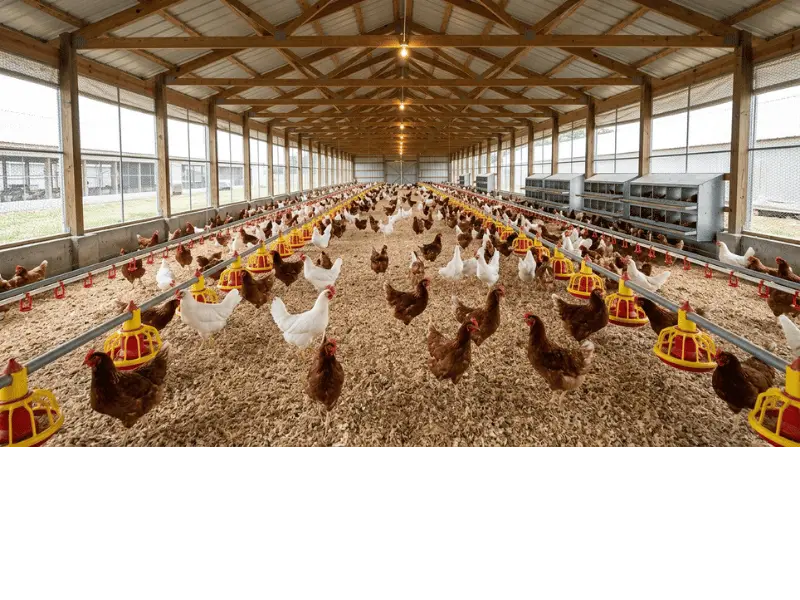
Master Layers Chicken Housing Requirements for a Thriving, High-Yield Flock
The core layers chicken housing requirements are 1.5 to 2 sq ft of floor space per bird in deep litter systems (about 450 to 550 cm² per bird in cages), one nest box for every 4 to 5 hens, 15 to 20 cm of perch space per hen, strong cross-ventilation, a temperature of 18 to 27°C, and 14 to 16 hours of light a day. Get these right and your flock will stay healthy and lay more eggs for longer.
Housing is the single biggest factor you control after feed. A layer hen spends nearly her whole productive life inside her shed, so the building decides how much heat stress she suffers, how clean her eggs are, and how easily disease spreads.
Stocking density is the number of birds kept per unit of floor area. Commercial benchmarks and backyard recommendations use different systems, so their figures are not interchangeable. A commercial cage allowance, for example, is not a practical target for a backyard coop with a run. Your plan needs to reflect how your birds live and how you will care for them.
This guide explains every part of layers chicken housing requirements in plain language, with metric and imperial figures and adjustments for hot, cold and temperate climates.
If you are still planning your farm, read our guide on how to start layer chicken farming first, then come back here to design the shed.
What Are Layers Chicken Housing Requirements?
Layers chicken housing requirements are the minimum standards for space, air, light, temperature, flooring, nesting and hygiene that a shed must meet so hens can stay healthy and produce eggs steadily. They apply whether you keep 20 hens in a backyard or 20,000 in a commercial farm.
A good layer house does five jobs:
- Protects birds from heat, cold, rain and predators
- Gives each hen enough room to eat, drink, roost and lay without stress
- Keeps air fresh and litter dry
- Makes daily work easy for the farmer
- Limits the entry and spread of disease
The Food and Agriculture Organization (FAO) lists space, ventilation and shelter among the basic principles of poultry housing, and notes that too little space leads to stress, disease vulnerability and cannibalism. You can read the full explanation in the FAO guide on poultry housing and runs.
How Much Space Does a Laying Hen Need?
Space is the most important of all layers chicken housing requirements because it decides how many birds you can keep and how well they behave. Overcrowding causes feather pecking, dirty eggs, higher mortality and lower production.
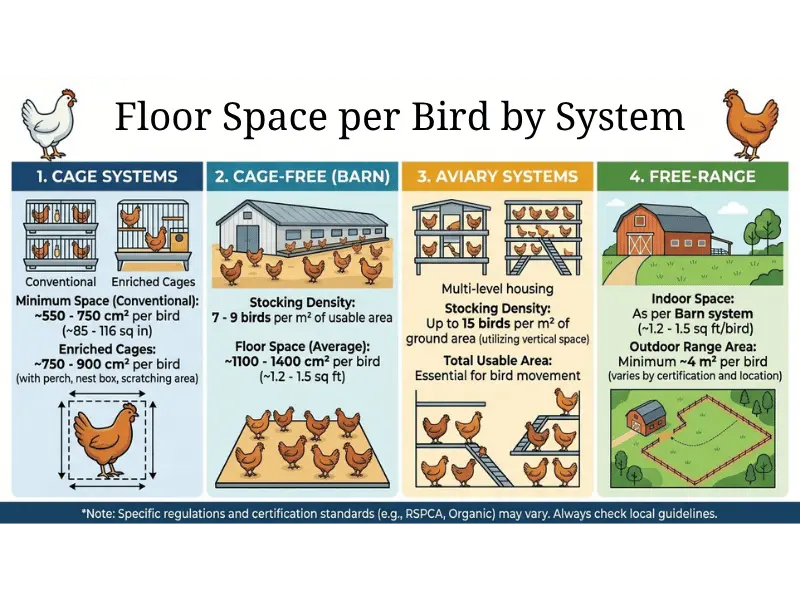
| System | Minimum space per bird | Stocking density and notes |
|---|---|---|
| Conventional cage | 550 to 750 cm² (about 85 to 116 sq in) | Older style cages with no enrichment |
| Enriched cage | 750 to 900 cm² | Includes perch, nest box and scratching area |
| Cage-free barn | 1,100 to 1,400 cm² (about 1.2 to 1.5 sq ft) | 7 to 9 birds per m² of usable area |
| Aviary (multi-level) | Up to 15 birds per m² of ground area | Uses vertical space; check local limits, as many standards count usable area instead |
| Free-range | Indoors: 1.2 to 1.5 sq ft, as in a barn system. Outdoors: at least 4 m² (about 43 sq ft) | Outdoor area varies by certification and location |
Specific rules and certification standards (such as RSPCA or Organic) vary, so always check your local guidelines.
Utah State University Extension suggests 1.5 to 2.0 sq ft of floor space per hen for small backyard flocks, which is a little more generous than the commercial barn figures above. See their backyard chicken housing guide for more detail.
Rule of thumb: If birds crowd around feeders, pile up in corners at night or show feather damage, your stocking density is too high. Remove birds or add space.
Wondering which breed suits your shed size? Lighter breeds such as ISA Brown are efficient with space. Learn more in our ISA Brown hen guide and our list of the best layer chickens.
Choosing a Housing System: Deep Litter, Cage or Free-Range
Your housing system shapes every other part of layers chicken housing requirements, from ventilation to labour.
Deep Litter System(Indoor)
Birds live on the floor over 4 to 6 inches of dry litter such as rice husk, wood shavings or chopped straw. It is the most popular choice for small and medium farms worldwide because it needs less investment and allows natural behaviour such as scratching and dust bathing.
Pros: Lower cost, good welfare, easy to start. Cons: Litter must be turned and kept dry, eggs may get dirty, disease can spread faster.
Cage System
Birds live in wire cages, usually in two to three tiers, with automatic feeding, watering and egg collection. It suits larger commercial farms.
Pros: More birds per shed, cleaner eggs, simple disease and production monitoring. Cons: High setup cost, welfare concerns, needs strong ventilation and reliable electricity.
Free-Range and Semi-Intensive
Hens shelter in a house at night and roam outside by day. It works well for desi and dual-purpose breeds and for farmers who want premium, naturally raised eggs.
Pros: Natural behaviour, premium egg price, lower feed cost. Cons: Exposure to predators, wild birds and weather. Needs land.
For a small setup at your own property, see our practical article on layers chicken farming at home.
Ventilation and Air Quality
Ventilation is one of the most overlooked layers chicken housing requirements, yet poor air quality quietly cuts egg production and invites respiratory disease.
Fresh air removes heat, moisture, dust and ammonia. Ammonia from wet litter is the biggest danger. If you can smell it strongly when you enter the shed, the level is already too high for the birds and should be corrected immediately.
Practical ventilation tips:
- Face the long side of the shed toward the prevailing wind so air can cross the building (cross-ventilation).
- Place openings near the roof line so hot air can escape, and cover them with wire mesh.
- Use adjustable curtains or sliding covers so you can reduce airflow in winter without sealing the shed.
- Install exhaust fans in closed or semi-closed houses, with fresh air entering from the opposite side.
- Keep litter dry. Fix leaking drinkers immediately, because wet litter produces ammonia fast.
Temperature Control in Hot and Cold Climates
Laying hens perform best between roughly 18 and 27°C. Egg numbers, egg size and shell quality fall when temperatures climb past 30°C, and heat waves above 40°C can cause heavy mortality.
For hot and tropical climates:
- Use an insulated roof or add a false ceiling or thatch layer
- Paint the roof white or with reflective paint
- Install cooling pads with exhaust fans, or foggers and sprinklers on the roof
- Plant shade trees on the west and south sides
- Provide cool, clean water and consider adding electrolytes during heat stress
- Feed more in the cooler early morning and evening hours
For cold climates:
- Close curtains partly at night, but never fully
- Use deep, dry litter for insulation
- Provide gentle heating for young pullets in the brooding stage
Temperature and feed costs directly affect your profit, as they affect market prices too. Our article on factors affecting chicken rates explains how production conditions influence what you earn.
Lighting Programme for Layers
Light stimulates the hormones that drive egg laying. Among all layers chicken housing requirements, lighting is the cheapest to improve and often brings quick results.
- Layers need a total of 14 to 16 hours of light per day (natural plus artificial).
- Increase light gradually, about 30 minutes a week, as pullets approach point of lay.
- Never reduce day length once hens are laying, as this can cause production to fall.
- Use warm white LED bulbs at low intensity (around 10 to 20 lux at bird level) and keep them evenly spaced to avoid dark patches.
- Give a consistent dark period of at least 6 to 8 hours so hens can rest.
Nest Boxes, Perches and Flooring
Nest Boxes
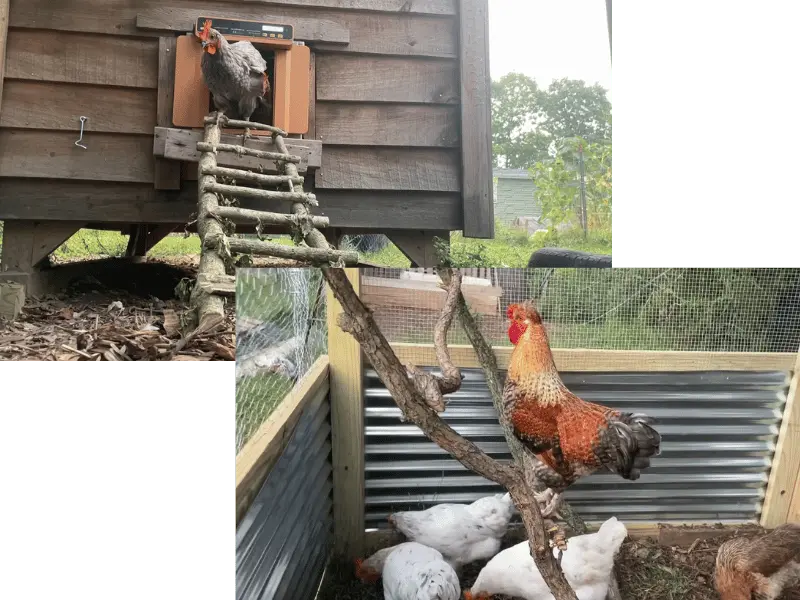
Hens want a quiet, dim, sheltered spot to lay. Without enough nests they lay on the floor, which leads to dirty and cracked eggs.
- Provide one nest box for every 4 to 5 hens, or a communal nest with at least 9 sq ft of nest space per 100 hens.
- A single box about 12 inches (30 cm) square suits most breeds.
- Place nests at least 18 inches (46 cm) off the floor, in a darker area of the house.
- Use a sloped roof on top of the nests so hens do not roost on them.
Perches
Hens have a strong instinct to roost at night.
- Allow 15 to 20 cm of perch space per bird; heavier breeds need the upper end.
- Make perches about 4 to 5 cm wide with rounded edges, to protect feet.
- Keep perches higher than the nest boxes, so hens sleep on perches instead of in nests.
- Leave about 30 cm between parallel perches and keep them away from direct draughts.
Flooring and Litter
- Concrete floor with a damp-proof layer is easiest to clean and disinfect.
- Litter depth of 4 to 6 inches works for deep litter systems; stir it regularly and top up as needed.
- Replace wet or caked litter immediately. Replace the whole lot between flocks.
- Slatted or wire floors over a droppings pit reduce disease contact but need strong ventilation.
Feeders and Drinkers
Birds that cannot reach feed and water easily will produce fewer eggs, so feeding space belongs among the essential layers chicken housing requirements.
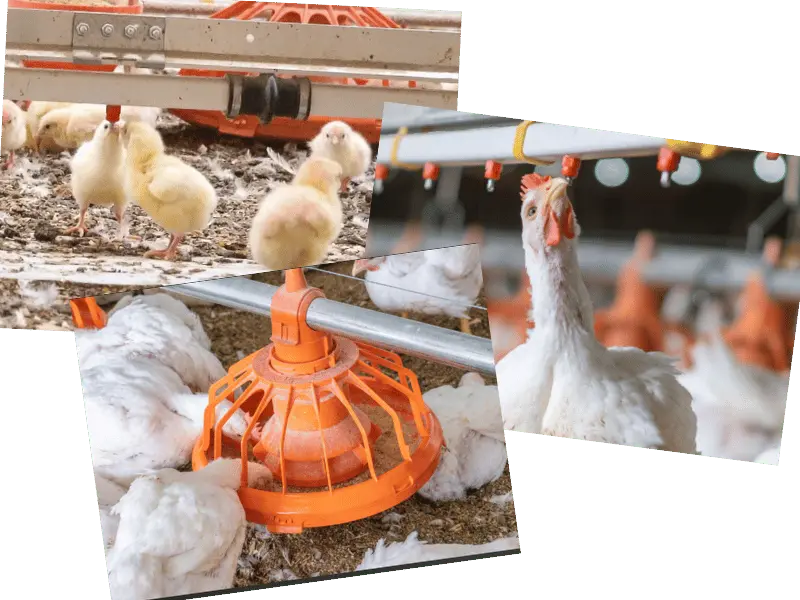
- Feeder space: about 10 to 12 cm of trough length per bird, or one circular feeder for every 25 to 30 birds.
- Water: nipple drinkers at roughly one nipple per 8 to 10 birds, or one bell drinker per 80 to 100 birds. Water must always be clean and cool.
- Adjust feeder and drinker height to the birds’ back level as they grow.
Feed quality matters as much as feeder design. Our broiler chicken feed guide explains feed basics, and the same principles of clean, fresh feed apply to layers.
Biosecurity and Predator Protection
A well-designed house is also a barrier against disease and predators.
- Build a footbath at the shed entrance and keep farm tools inside the farm.
- Allow only essential visitors and make them wear clean boots or covers.
- Use wire mesh on all openings to block wild birds, rodents, snakes, cats and foxes. Rats and wild birds carry diseases and eat feed.
- Follow a proper vaccination routine. Our vaccination schedule for broiler chickens shows how a schedule is structured, and your veterinarian can adapt it for layers.
Frequently Asked Questions About Layers Chicken Housing
How much space does a layer hen need?
In a deep litter shed, give each hen 1.5 to 2 sq ft of floor space. In cages, allow 450 to 550 cm² per bird. More space generally means fewer pecking problems and better egg quality.
How many nest boxes do I need for 100 laying hens?
Plan for 20 to 25 individual nest boxes for 100 hens (one box per 4 to 5 hens), or a communal nest with at least 9 sq ft of nesting space.
What is the best temperature for laying hens?
Layers do best between 18 and 27°C. Above 30°C, production, egg size and shell quality decline, so cooling becomes essential in hot summers and tropical regions.
How many hours of light do layers need?
Layers need 14 to 16 hours of total light per day. Increase day length gradually before laying starts and never shorten it during the laying period.
What is the best housing system for layers?
Deep litter is the best starting point for most small and medium farmers around the world because of low cost and good welfare. Cages suit large commercial farms with strong management and electricity supply.
Conclusion
Meeting the layers chicken housing requirements is not about expensive buildings. It is about getting the basics right: enough space, fresh air, stable temperature, regular light, comfortable nests and perches, clean feed and water, and good biosecurity. Farmers who follow these standards see healthier birds, more eggs per hen and better profit over the laying cycle.
Ready to go further? Study our guide on egg production in chickens and check our guide to egg laying hens page to choose breeds that fit your shed. Planning your budget? Use our poultry farming business plan.